


Why Atlanta Anglers Make the 2.5-Hour Drive
Atlanta is exceptional fly fishing territory. The Chattahoochee tailwater runs through the city, and within two hours you can reach the Toccoa River, the Noontootla, and the headwater streams of the North Georgia Blue Ridge — genuine freestone wild trout water that has made Atlanta a starting point for serious anglers for decades. Atlanta fly fishers are not short on places to fish.
What they are often short on is instruction that explains what is actually happening — the mechanics behind why a cast does what it does, the strategy behind a drift that produces fish, the reason one approach works on a given piece of water and another does not. That gap is what drives Atlanta anglers north on US-76 toward the Smokies.
Bryson City, North Carolina is approximately 3–3.5 hours from Atlanta. The Tuckasegee River — the school’s primary training water — is a tailwater with the size, current variety, and fish density that supports serious instruction at every level. Wild tributary streams running through Great Smoky Mountains National Park and the surrounding National Forest fill out an environment that has no equal in the South for guide school training. Students fish the Tuckasegee River and wild Smoky Mountain streams in real conditions — not a casting pond.
Graduates from Atlanta describe the experience consistently: four days at the school gave them more actual understanding of fly fishing than years of independent practice and guided trips that covered the what without ever explaining the why. The curriculum teaches mechanics, strategy, and on-water application together — and that changes the way you approach the water for the rest of your life.
For Atlanta anglers, the drive also unlocks something with no equivalent closer to home: a faculty of four FFI Master Certified Casting Instructors, Fly Fishing Team USA members and coaches, World Championship medalists, Hall of Fame inductees, and certified whitewater rowing professionals — all in a single four-day program with a tuition of $4,850.
The Faculty
The Fly Fishing Guide School maintains the most credentialed fly fishing faculty assembled anywhere in the eastern United States. Ten instructors bring a combined 450+ years of on-water experience across competitive casting, professional guiding, whitewater rowing, entomology, and conservation work.

Mac Brown
Head Instructor & Founder
FFI Master Certified Casting Instructor · Field & Stream Angler of the Year · Fly Fishing Show presenter since 1994

Eric Cook
FFI Master Certified Casting Instructor
FFI Board of Governors · Instructor of the Year nominee · Atlanta Fly Fishing School

Tom Rueping
FFI Master Certified Casting Instructor
FFI Instructor & Mentor of the Year nominee · SE Council CICP Coordinator · Lee University

Michael Bradley
Fly Fishing Team USA
World Championship: Team & Individual Bronze · 11 FFTUSA competition medals · 4× Rumble champion

Ken Kastorff
Hall of Fame Inductee
50+ years on the water · Co-founder, Endless River Adventures · Co-developed the C-to-C roll technique

Pip Coe
Outdoor Educator & Whitewater Professional
34+ years NOLS Field Instructor · 7 years Nantahala Outdoor Center · Wyoming Woman of Influence

Tony Brooks
FFI Certified Casting Instructor
45+ years on the water · Professional guide since 2009 · U.S. National Championship competitor

Will Percy
Fly Fishing Guide & Community Advocate
Guide School graduate · Trained under FFI Masters & Team USA · Project Healing Waters founder

Cassie Spurling
Fly Fishing Guide & Instructor
Licensed guide — NC & North Georgia · Lee University fly fishing scholarship · Conservation advocate

Patrick Weaver
Fly Fishing Instructor & Author
Author, Hatches of Pisgah Forest (2025) · 30+ years instruction · Aquatic entomology specialist
What Four Days on the Water Actually Looks Like
The school runs four days, starting Thursday at 8 AM and concluding Sunday at 3:30 PM with the Certificate Presentation. There are no passive classroom lectures. Instruction happens in the field, on the Tuckasegee River, with immediate feedback and real conditions. Here is what the four days cover:
Morning — Casting Mechanics & Rod Work
Each day begins with casting work on the lawn and river bank led by our credentialed instructor team, which includes FFI Master Casting Instructors. Instructors vary by session. Topics include loop formation, tracking, hauling, and presentation casts for specific situations (reach cast, curve cast, slack-line presentations). Rod performance, line tapers, and leader construction are covered in the context of when and why they matter on the water. Ingrained habits are identified and corrected on the spot.
On the River — Application Under Instruction
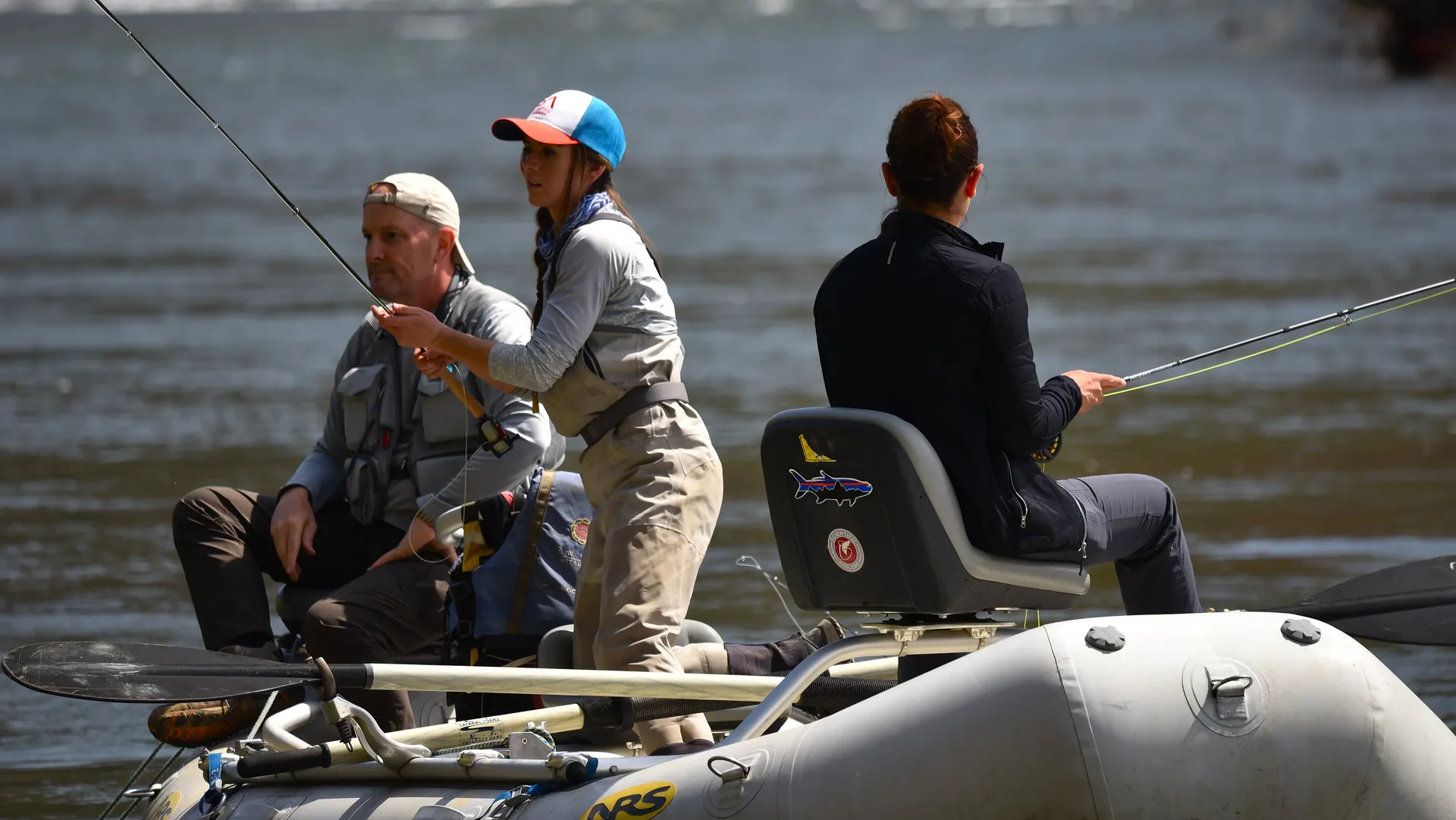
Wade sessions on the Tuckasegee and Smoky Mountain wild streams put casting mechanics into immediate application — nymphing (indicator and tight-line), dry fly presentation, streamer technique, water reading, hatch identification, rigging for every condition, hook setting, and the five-component fish-fighting system. Instructors are on the water with you, correcting in real time.
Drift Boat — Rowing, Positioning & Boat-Side Instruction
Students rotate through the oars with certified whitewater rowing instructors — river reading from a rowing position, ferry angles, eddy use, boat positioning for client success, and the fundamentals of safe river running. Career-track students receive additional sessions in guiding methodology, client communication, trip planning, and the business of professional guiding.
Optional Evenings in Bryson City
Evenings are optional group dinners at local Bryson City breweries or restaurants, paid for by participants. Mac Brown’s personal library of 300+ fly fishing books and DVDs is available to students during the school, not as a scheduled evening activity. The school begins Thursday at 8:00 AM and concludes Sunday at 3:30 PM with the Certificate Presentation.
Atlanta Home Water — and What Changes After the School
Most Atlanta graduates return home to the Chattahoochee, the Toccoa, the Noontootla, and the North Georgia mountain streams with a fundamentally different approach. The five components — casting, line control, hook setting, playing fish, and landing fish — no longer feel like separate skills to think about. They work together, and when they do, the fishing changes at a level that surprises most people.
Eric Cook, one of the school’s four FFI Master Certified Casting Instructors, teaches at the Atlanta Fly Fishing School and knows the Atlanta fly fishing community well. His presence on faculty gives Atlanta students a direct connection to instruction rooted in the same region and a resource for continued development after they leave Bryson City.
Sessions run March through November. The school fills months in advance — Atlanta anglers who wait until spring typically find summer and early fall dates already taken. Tuition is $4,850 for the full program. Lodging is arranged separately; Bryson City has excellent options at every price point within minutes of the training water. Most students stay three or four nights.
To reserve a seat, visit the reservation form, call or text (828) 736-1469, or email flyfishingguideschool@gmail.com.
Frequently Asked Questions
How far is the Fly Fishing Guide School from Atlanta, GA?+
Bryson City, North Carolina is approximately 2.5 hours from Atlanta via US-76 West. The drive takes you through the North Georgia mountains and into the most productive trout-fishing region in the eastern United States — the same water where the school trains every session.
Is the school designed for recreational anglers, or only people who want to become professional guides?+
Both tracks are fully supported. The Fly Fishing Guide School runs alongside the Smoky Mountain Fly Fishing School — a recreational track covering the same curriculum without the guiding methodology component. Both programs use the same faculty, the same water, and the same four-day format. The instruction is identical where it overlaps; the recreational track focuses on personal skill development rather than the business of professional guiding.
What fly fishing experience level is required to enroll?+
No prior fly fishing experience is required. The school accepts complete beginners through experienced anglers looking to close specific gaps. The faculty is accustomed to working with students at every level simultaneously — the curriculum teaches fundamentals from first principles, which benefits beginners and corrects ingrained habits in experienced anglers alike.
What is included in the $4,850 tuition?+
Tuition covers the full four-day program — daily on-water sessions on the Tuckasegee River and Smoky Mountain wild streams; access to 100+ high-end fly rods and multiple fly line tapers; a complete fly tying setup; switch rod and double-handed rod instruction; Mac Brown's personal library of 300+ fly fishing books and DVDs; a worldwide job placement directory. Lodging is not included and is arranged separately by each student.
How is this different from fly fishing instruction available closer to Atlanta?+
The primary difference is faculty credentials and water quality. The Fly Fishing Guide School assembles four FFI Master Certified Casting Instructors, Fly Fishing Team USA members and coaches, World Championship medalists, and Hall of Fame inductees for a single four-day program. That combination does not exist within a day's drive of Atlanta. The Tuckasegee River training environment — a productive tailwater with wild trout and current variety — also cannot be replicated on local Georgia water.
Who are the instructors at the Fly Fishing Guide School?+
The faculty includes Mac Brown (FFI Master Certified Casting Instructor, Field & Stream Angler of the Year, Fly Fishing Show presenter since 1994), Eric Cook (FFI Master Certified Casting Instructor, Atlanta Fly Fishing School), Tom Rueping (FFI Master Certified Casting Instructor, FFI Instructor and Mentor of the Year nominee), Michael Bradley (Fly Fishing Team USA, World Championship Team and Individual Bronze medalist), Ken Kastorff (50+ years on the water, Hall of Fame inductee), Pip Coe (34+ years NOLS Field Instructor), Tony Brooks (FFI Certified Casting Instructor, professional guide since 2009), and Will Percy (Guide School graduate, Project Healing Waters founder).
When do sessions run and how far in advance should Atlanta students book?+
Sessions run March through November in Bryson City, North Carolina. The school fills months in advance — Atlanta anglers who wait until spring to inquire typically find summer and early fall dates already taken. Early reservation is strongly recommended.
Where do out-of-town students typically stay in Bryson City?+
Bryson City offers excellent lodging options at every price point — from riverside cabins and vacation rentals to downtown bed-and-breakfasts and hotels. Most students stay three or four nights. Lodging is not included in tuition and is arranged directly by each student. The school is happy to recommend options based on your preferences and budget.
What will I actually be able to do differently after four days at the school?+
The school works on five components: casting, line control, hook setting, playing fish, and landing fish. Students leave with corrected casting mechanics, an understanding of presentation strategy for different water types, the ability to read current and position for drift, reliable hook-setting technique, and the confidence to self-correct on any water after the school. Most graduates describe it as the first time they understood not just what to do, but why — and that changes how they approach the water permanently.
Is the instruction the same for recreational students and career-track students?+
The technical curriculum — fly casting, water reading, rigging, nymphing, dry fly, streamer technique, drift boat operation — is identical for both tracks. Career-track students receive additional instruction in guiding methodology, client communication, trip planning, and the business of professional guiding. Both groups fish together, cast together, and row together throughout the four days.
Related Posts
Fly Fishing Guide School
Fly Fishing Classes in North Carolina Smoky Mountains for Trout Fishing
Read →